Skip to content
Cardhansa

The Cardhansa card condition guide

Grading standard

Judging the condition of a card stirs emotions, because it feeds straight into the valuation and it can be subjective. Detailed standards are still rare on the European market, so both sides are left to guess where one grade ends and the next begins. We want to settle that for good.

At Cardhansa we verify cards against detailed standards modelled on the best global practice, and we hold both sides of a transaction to the same bar. Every grade is defined by how far each specific imperfection is allowed to go, so a grade can be assigned clearly and transparently.

Use the collection buyback and you do not have to worry about grading: we do it for you.

Sell Collection

Five rules for grading card condition

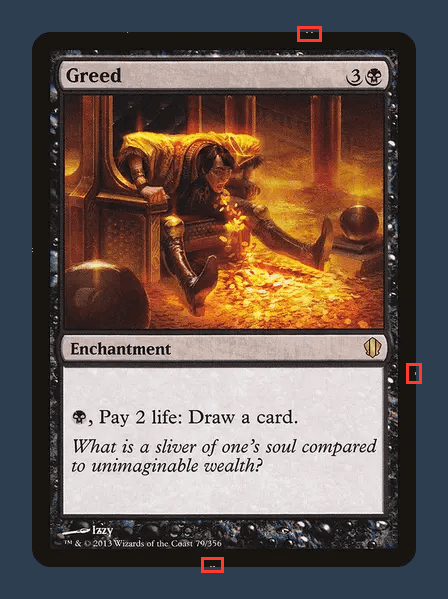
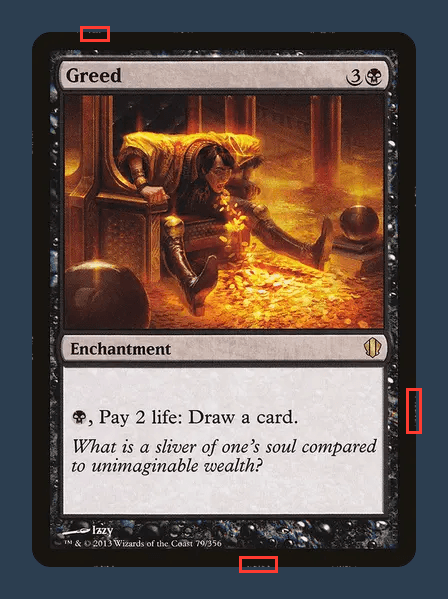
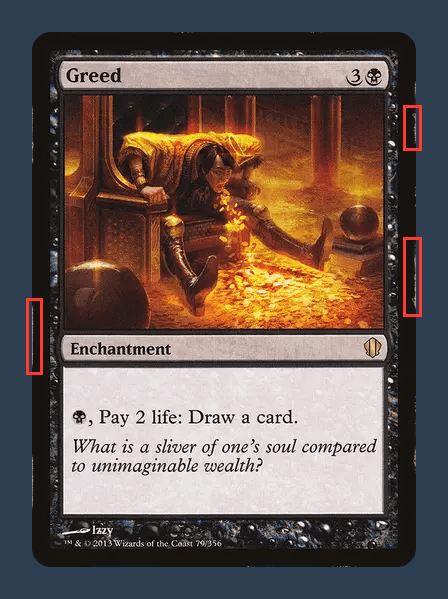
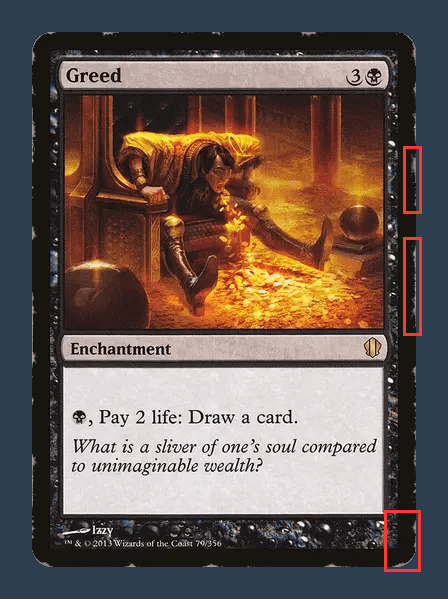
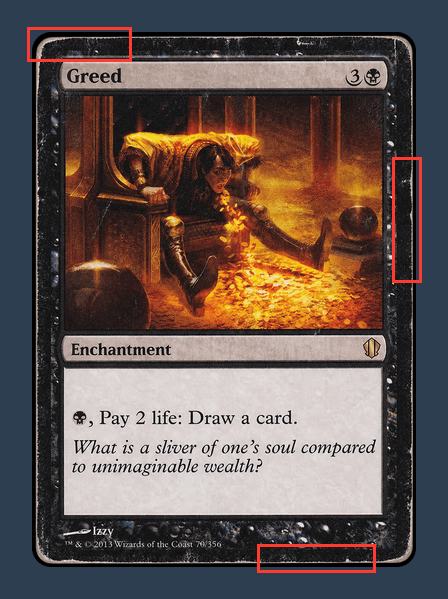
Check the five markers on the card below. If you have to answer "yes" to any of the questions, your card is not Near Mint and you should grade it against the scale.

  1. You do not have to be an expert to grade a card. If we spot differences from the standard while verifying your cards, we will let you know. Wrong grades can, however, slow the valuation of your order down.

  2. To grade a card, look at both of its sides in daylight, at arm's length. Run the five check questions marked on the card alongside with the letters A to E. The worse of the two sides sets the grade.

  3. If you had to answer "yes" to even one of the questions, check below which is the best grade that covers all of that card's damage. That is the grade of your card.

  4. Check foils at an angle as well, in reflected light. and scratches on the foil layer are often visible only that way.

  5. , meaning an error of printing or manufacture, does not lower the grade of a card. The grades from Near Mint to Poor judge how damaged a card is, not how perfectly it was printed. The exception is a defect that affects the structure of the card or the legibility of its content: a cut that removes part of the artwork or of the text, foil separated from the card stock and text that cannot be read all mean PO.

The Card Condition Policy sets out the detailed grading rules.

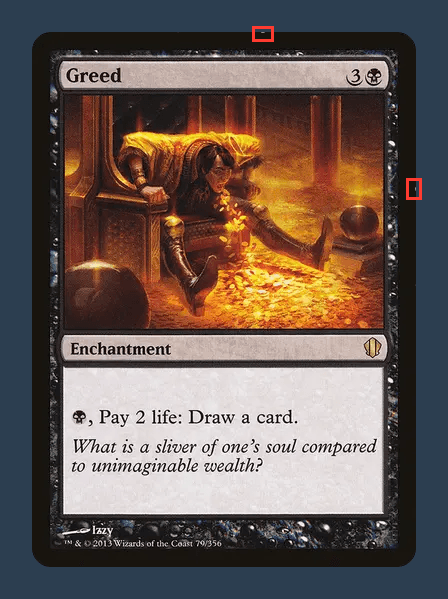
Near Mint: Fresh from a booster

This card has hardly ever left its sleeve. In daylight, at arm's length, nothing draws the eye: no on the surface, no , no trace of dirt.

Only barely visible imperfections are acceptable, meaning the ones that show up once you tilt the card to the light, or single white dots. That covers two or three fine up to about 10 mm visible only at an angle, barely visible over a small area, and single tiny white points on the edges or on one corner. The corners stay sharp. of a foil up to about 5 mm off a flat surface does not affect the grade.

The card is not Near Mint but EX if even one of these imperfections is present:

  • more than two or three white points show along an edge
  • whitening is visible along any one edge
  • even a small dent is visible
  • a foil shows any clouding at all

Detailed grading criteria for NM

The table gives the maximum extent of each imperfection at which the card still holds the NM grade. Anything beyond that level means the grade one step lower.

Criteria for NM (Near Mint), part 1 of 2
ImperfectionAt most, acceptable at NM
single tiny white points, a few at most on the card, without a continuous stretch of wear
barely visible softening of at most one or two corners, with a trace of whitening on at most one; the corners stay sharp
None
at most two or three fine scratches, visible only at an angle, each up to about 10 mm
over a small area, visible only at an angle
None
None
Criteria for NM (Near Mint), part 2 of 2
ImperfectionAt most, acceptable at NM
None
None
Up to about 5 mmof lift from a flat surface
Factory defectsAny short of damaging the cardallowed where they affect neither the structure nor the legibility of the card; they do not lower the grade
None
None
None
Excellent: The first distinct marks

The card has been played without a sleeve, but not for long. Its first marks are distinct and visible straight on, yet all of them stay spot-like: does not reach every corner, plus single points along the edges, separated from one another, without a continuous stretch of wear.

The wear keeps to the edge itself and does not reach the surface of the card. The corners stay sharp and the surface keeps its gloss across the whole side. EX also allows isolated scratches visible only at an angle, up to about three per side, barely visible dulling, and one or two pinpoint dents that do not show through. There is no dirt, no bend and no crease at this grade.

The card is not Excellent but GD if even one of these imperfections is present:

  • whitening forms continuous stretches along the edges
  • whitening covers more than three corners
  • whitening moves from the edge onto the surface of the card
  • scratches show straight on, without tilting the card

Detailed grading criteria for EX

The table gives the maximum extent of each imperfection at which the card still holds the EX grade. Anything beyond that level means the grade one step lower.

Criteria for EX (Excellent), part 1 of 2
ImperfectionAt most, acceptable at EX
single white points, separated from one another, without a continuous stretch of wear; they do not reach the surface of the card
tiny white points visible straight on, on up to three corners; the corners still sharp
None
isolated scratches visible only at an angle, up to about three per side, none visible straight on
small dulled areas visible only at an angle, the gloss of the whole side intact
visible only at an angle
None
Criteria for EX (Excellent), part 2 of 2
ImperfectionAt most, acceptable at EX
isolated pinpoint dents that do not show through to the other side
None
Up to about 5 mmof lift from a flat surface
Factory defectsAny short of damaging the cardallowed where they affect neither the structure nor the legibility of the card; they do not lower the grade
None
None
None
Good: Played unsleeved

This card has spent many an evening on the table. The on the corners is distinct and visible from a normal distance, it covers several corners, and the corners may be slightly rounded.

Along the edges the wear forms short continuous stretches, though not around the whole perimeter, and in places it moves off the edge onto the surface of the card as single small points. The surface loses its gloss over part of a side, scratches now show straight on, and are there from close up. GD allows no .

The card is not Good but LP if even one of these imperfections is present:

  • whitening runs around practically the whole perimeter of the card
  • whitening covers all the corners
  • whitening moves onto the surface in patches
  • the card has a bend, even one that does not break it

Detailed grading criteria for GD

The table gives the maximum extent of each imperfection at which the card still holds the GD grade. Anything beyond that level means the grade one step lower.

Criteria for GD (Good), part 1 of 2
ImperfectionAt most, acceptable at GD
whitening visible straight on in many places, in places short continuous stretches, but not along the whole perimeter
distinct whitening on several corners, visible straight on; the corners may be slightly rounded
single small white points on the surface, mostly near the edges
up to a few scratches visible straight on, each up to about 10 mm
dulling visible straight on over part of a side, the rest keeping its gloss
visible straight on over part of the foil
traces of handling, visible from close up
Criteria for GD (Good), part 2 of 2
ImperfectionAt most, acceptable at GD
single dents visible straight on that do not show through to the other side
None
Any short of breakingany curl that does not permanently break the card
Factory defectsAny short of damaging the cardallowed where they affect neither the structure nor the legibility of the card; they do not lower the grade
None
None
None
Light Played: Wear all the way round

Played without a sleeve for a long time and shuffled hundreds of times. runs around practically the whole perimeter of the card and covers all the corners, visibly soft or rounded, and from the edges it moves onto the surface in patches visible at a glance.

The surface is dulled over a large part of a side, and scratches, longer ones included, no longer need an angle to show. LP still allows a bend that does not break the card, visible dirt that is not ingrained, and a small amount of without exposing the core.

In a sleeve an LP card remains fully playable and indistinguishable from the other cards in the deck; that is what this boundary rests on. Remember too that the European LP is not the American Lightly Played, so compare the descriptions, not the names.

The card is not Light Played but PL if even one of these imperfections is present:

  • deep scratches cover the surface of the card
  • the dirt is ingrained into the card
  • pressure marks show through to the other side
  • the card has a crease, meaning a permanent fold line

Detailed grading criteria for LP

The table gives the maximum extent of each imperfection at which the card still holds the LP grade. Anything beyond that level means the grade one step lower.

Criteria for LP (Light Played), part 1 of 2
ImperfectionAt most, acceptable at LP
whitening along practically the whole perimeter of the card
whitening on all the corners, the corners visibly soft or rounded
whitening spread over parts of the surface, visible at a glance
many scratches visible straight on, longer ones included, but no deep scratches covering the surface
a dull surface over a large part of a side
clouding over most of the foil
visible dirt that is not ingrained
Criteria for LP (Light Played), part 2 of 2
ImperfectionAt most, acceptable at LP
single dents visible straight on, which may show through; no pressure marks across the card
A bend, no creasea bend that does not break the card
Any short of breakingany curl that does not permanently break the card
Factory defectsAny short of damaging the cardallowed where they affect neither the structure nor the legibility of the card; they do not lower the grade
None
a small peel or rippling of the surface layer, without exposing the core
None
Played: Heavy wear

The card shows obvious, heavy wear and several imperfections at once: heavy damage to the edges, the corners and the surface, ingrained dirt, deep scratches, pressure marks and bends.

The corners are worn down and rounded until the layers of the card stock may show, and the edges can be frayed. The card keeps its structural integrity, but bends, pressure marks or a crease may be recognisable even through a sleeve: such a card may be treated as marked and unfit for tournament play.

The card is not Played but PO if even one of these imperfections is present:

  • the card is torn or has a piece of material missing
  • a crease breaks the structure of the card
  • there is ink or writing on the card
  • there is any signature on the card

Detailed grading criteria for PL

The table gives the maximum extent of each imperfection at which the card still holds the PL grade. Anything beyond that level means the grade one step lower.

Criteria for PL (Played), part 1 of 2
ImperfectionAt most, acceptable at PL
whitening along the whole perimeter, the edges frayed
corners worn down and rounded, the layers of the card stock may show, no corner broken off
whitening spread across the surface of the card
deep scratches covering the surface
a dull surface over both sides
clouding over the whole foil
ingrained dirt
Criteria for PL (Played), part 2 of 2
ImperfectionAt most, acceptable at PL
dents and pressure marks, which may show through to the other side, none of them puncturing the card
pronounced bends, or a crease that does not break the card
Any short of breakingany curl that does not permanently break the card
Factory defectsAny short of damaging the cardallowed where they affect neither the structure nor the legibility of the card; they do not lower the grade
None
peeling and rippling over a larger area, the layers of the card stock still holding together; signs of contact with liquid that have neither deformed nor stained the card
None
Poor: Damage

PO is a card with damage that goes beyond wear from play: broken corners, tears, missing pieces, creases that break the card, , ink marks or writing.

Any card carrying a signature falls into PO automatically, even an artist’s. Inked and altered cards are graded the same way, with repainted artwork or touched-up edges. We do not buy those cards. We expect that in the future we will also buy cards signed by the artist and altered cards, and we will announce that separately.

PO is the lowest grade on the scale, so it has no boundary below it. A card in a worse state than described here is still PO.

Detailed grading criteria for PO

PO is the last grade on the scale, so the table says what the grade covers, not how far an imperfection may reach. A card in a worse state than the table describes is still PO.

Criteria for PO (Poor), part 1 of 2
ImperfectionCovered by PO
Anyincluding edges with material torn away
Anyincluding corners broken off or missing
Anyincluding whitening over the whole surface of the card
Anyincluding scratches that cut into the card stock
Any
Any
Anyincluding stains and substances that have soaked into the card
Criteria for PO (Poor), part 2 of 2
ImperfectionCovered by PO
Anyincluding dents that puncture the card
Anyincluding a crease that breaks the structure of the card
Anyincluding curl that has permanently broken the card
Factory defectsAnyincluding defects that affect the structure or the legibility of the card
Anyink, writing, any signature, repainted or altered artwork
Anyincluding peeling that exposes the core and rippling across the whole card
Anytears, holes, missing pieces, splitting of the card stock that exposes the core, water damage that has deformed or stained the card

Extra guidance for foils

Foils are graded in reflected light, at an angle

The foil layer shows every mark, so we grade foils more strictly. We check them at an angle, with the card in motion, because clouding and scratches only appear in reflected light.

The natural curl of a foil depends mostly on the humidity around it. At Cardhansa and at the publishers, cards are kept in controlled conditions. A card received from our warehouse may curl more in a damper room than it did when we verified it: that does not worsen the grade it had at dispatch. In the buyback we assess the threshold of about 5 mm in our own storage conditions.

  • you can see at all, even at an angle: EX at best.
  • Clouding visible straight on over part of the foil: GD at best.
  • Clouding over most of the foil: LP at best.
  • A scratch on the foil layer visible straight on: GD at best.
  • Curl up to about 5 mm off the surface changes nothing. It does not feed into the "is the imperfection visible in a sleeve" test. More than that: GD at best. Curl that permanently breaks the card means PO.
  • and under about 1 mm are factory defects and do not lower the grade. A bubble that lifts the foil off the card stock means PO.

Any questions about how we grade? We are here on chat.